
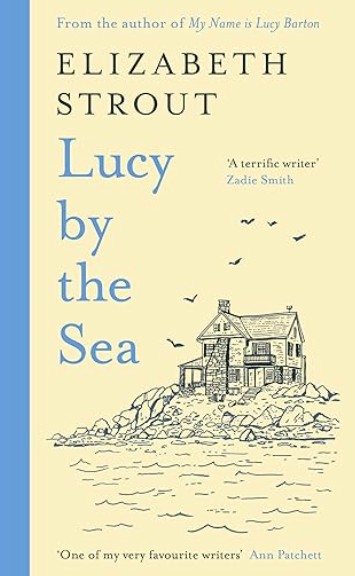
A second reading of this book made for a very different experience than the first. Lucy’s first husband, William, calls Lucy and demands that she pack a bag and move with him to Maine. They haven’t lived together for many years and she can’t understand what the hurry is but Covid has hit New York and William wants out. They move to Maine in a rented house on the sea front and wait. The book then details all the people, conversations and events that happened to them during lockdown and the fact that Lucy and William get back together again.
The first time I read this book back in 2023 I was immediately taken with the pandemic element of the story, the lockdown, the fear and the strange ways in which we met to talk – outside and distanced. This reading allowed me to focus on the elements of the story, I am not sure you would call this a story, and what was happening in Lucy’s life and it was not as pleasurable an experience.
Told in first person through Lucy’s eyes, you are very much inside her head, an unsettling, scattered place that leaves you exhausted in places. She seems incapable of looking after herself, needing William to make decisions about the pandemic and staying safe, William to buy her a winter coat and to do the cooking whilst she flits about not settling. She does go outside and walk every day and talk to people that she meets – all distanced but there is something about the writing that I found quite irritating.
Strout is the master of qualifying parts of and whole sentences. In the first part of the book I counted 58 different adverbs ending in -ly which is an unusually high number. The effect is to qualify the verbs making them specific but still remain vague. She does this in other ways:
It was not quite the middle of June . . .
So it wasn’t the 15th of June but what was it and was the timing important for the story she was about to tell? No.
Frequently, after a story had been told we hear ‘I get it’, or ‘I thought so’ or ‘I understand’ and so we as the reader have to work out what she understands or gets and there is quite a lot of that work to do. The writing is fragmented and quite speech like and she has a habit of ending paragraphs with a sentence that is quite emphatic or opposes what she has just been saying.
There were moments of quite profound thoughts and I suspect this along with the cast of characters that Lucy meets are what other readers love about this book but for me it was not as good the second time around.
The one part I really disliked in the book was when Lucy found she did have a story to write after having writer’s block for most of the time. Here, we then get the story’s characters – Arms, Legs and Sperm – and it really was not a good piece of writing. It was awful, making me feel as if Lucy wasn’t really a writer and I had seen Lucy as Strout and this as a piece of almost autofiction. Am I wrong?
 Trying to read all the good books
I’d love to hear what you think