
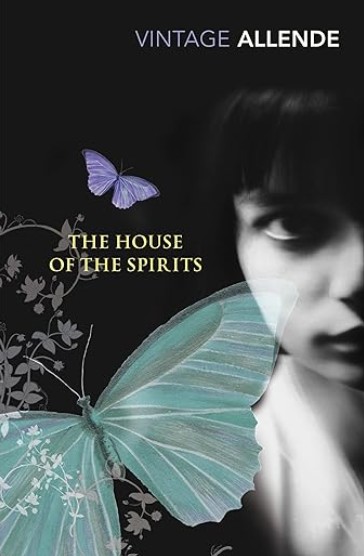
I first read this book nearly forty years ago and so it is a real pleasure to come back to it now for book club and decide if I still think the same things or whether I have changed my mind.
Set in the early 20th century, The House of Spirits tells the story of three generations of one family alongside the political dramas that the country, never named but widely believed to be Chile, is undergoing. Esteban Truba marries Clara del Valle, a woman with clairvoyant skills who connects to the spirit world more frequently than she does with reality it seems. We then follow her daughter, Blanca and her daughter, Alba. The names must mean something in this book: Clara from Latin origin meaning clear or translucent; Blanca Spanish for white and Alba from the Latin for white. Perhaps the names suggest that the women in the family are transparent and are pure.
What complicates the family relationships are the men that these three women fall in love with, or marry even when there is no love, and this is often used to highlight the themes of class, justice and social struggle. But what really stands out in this book is the use of magical realism, not something I was familiar with forty years ago and not something I warm to even now. However, what I do know as a reader today is that it is there for a reason, and it is that use and purpose that I want to explore a bit more.
The warning for magical realism in the book is a thought that flits through my head as I read which follows similar lines to ‘that’s a bit silly’ or ‘what’s the point of that?’ and causes me to go back and check that I have read it correctly. Quite early on in the book we meet Barrabas the dog that Clara looks after which has a tail ‘as long as a golf club’, crocodile claws, is as big as a horse and is generally a mishmash of animal parts. Her father threatens to kill Barrabas until Clara says she will hold her breath and not breathe again and die, and because her father knows of her ‘otherworld’ skills he believes her and the dog is reprieved. Here, Clara is demonstrating power over men using her skills even as a child in a patriarchal society. And this power continues into adulthood and married life. The tail being compared to a golf club is also telling in terms of the class structure of the day and where this family belongs.
These fantastical animals appear a couple more times in the book made out of clay by Blanca and embroidered onto a tablecloth. They consist of beasts made out of different animal body parts symbolising a blending of opposites or diverse talents but also of strength, wildness, fertility or a million other things depending on the body parts used. Also known as chimera, they can refer to an unreasonable or impossible dream or idea but in the case of the clay figures provide a means of survival through selling them.
One element that I found difficult to believe was Clara’s absolute avoidance of anything domestic once married. But again, this is a refusal to bow to her husband Esteban Trueba who has a foul temper, is a rapist and belongs to the rightwing of politics where he wants to uphold the status quo in society in his favour. He uses violence to get his own way although Clara, who is often held between reality and the spirit world almost in a dream-like state, is the only one who is not cowed by him. The spirit world protects her by giving her somewhere else to go when all around is chaos and anger.
Alba also exists in this space of merging realms when she is captured and tortured by a man who she knew when she was a child. Alba calls out to Clara’s spirit to help her die at one point during her torture but Clara insists that she survive and to write her story in her head ready for when she is free again and can record it on paper. These merging realms prove empowering for both women to enable them to endure and also provide a place where the spirit can survive.
One of the other surprise and disbelief moments in the book was when the description of how the house had been extended as more space was needed. The additions were labyrinthian with turrets, twisted staircases going nowhere and windows and shutters that didn’t open all overseen in construction and upkeep by Clara. The rooms provided spaces for people and goods to be hidden because no one, particulary the men, knew what the layout of the house was, prefering to stick to the rooms they knew best. Here we have a woman shaping her world and the world into the future as the house becomes a stopping off place for people who need to escape the country at one point in the story.
There are plenty of other elements of magical realism in the book but all of them are used mostly to show women in control, shaping their worlds and empowering them to resist. I can see how this would have been much more difficult to convey if the magical realism had not been used and I now think it essential to the story, which I didn’t forty years ago.
Towards the end of the book when there is the Pinochet coup, Pinochet is not named, it becomes clear that for all their spiritual connections and beliefs, they can’t be used to save people from political turmoil and disappearance. And this reintroduces us to another woman who pops up throughout the book, Transito Solo, a prostitute who foresees that she will be rich and comfortable and who uses the political upheavals to make her fortune. With the change of government to a left-leaning one, Transito creates a co-operative brothal that becomes very lucrative and then with the coup, changes to a hotel, of which she is the owner, that is used by men and their mistresses. So unlike the Trueba family who seem go into decline as the political changes are made in the country, Solo adapts and uses them to her benefit and pays her debts, saving the family at the end.
It is generally believed that this book, Allende’s first novel, is her best and some also think that she has ‘borrowed’ perhaps a little too much from Gabriel Garcia Marquez’s One Hundred Years of Solitude. That book follows a family over seven generations but focuses on the men and shows the rise and fall of the family. These ideas are not unusual in family sagas and I prefer to think of Allende’s book as a response to Marquez with women as the central characters in a family. It is a book that definitely needs feminist filters on when you read it.
 Trying to read all the good books
I’d love to hear what you think