
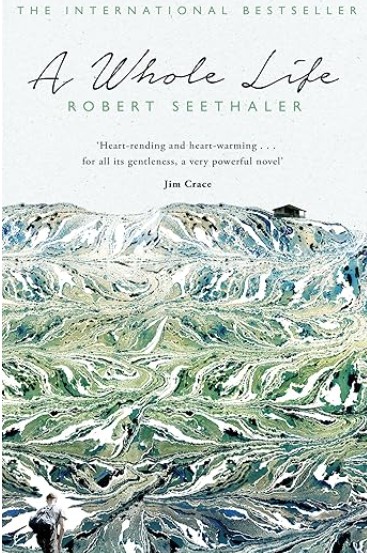
Translated by Charlotte Collins
There are more books now that quietly show us the life of a person such as Stoner by John Edward Williams. It seems as if nothing momentous happens in the lives of these characters but it does it’s just that they are written about in the same way as every other event. Nothing is made of it in terms of extra detail or any detail in some cases but that I think that is because in the grand scheme of a life it fades into the background as living is continued.
A Whole Life is a short novel that shows us Andreas Egger’s life in the Austrian mountains from the age of four when he was abandonned with a farming relative because his mother has died to the moment he dies.
As a child he was beaten regularly until at the age of eighteen when he had become strong, he refused to be beaten and told the farmer he would kill him if he continued. Egger then lives and works in the area as a manual labourer until progress comes to the village in the form of a cable car. He gets work building the transport system and goes on to build many more in the valley. In the meantime he meets Marie and asks her to be his wife by burning bags laid out in the shape of her name on the mountainside. He is a man of few words.
If you live in the mountains, you will be very aware of avalanches, and a massive one, heard first, wipes out Andreas’s cottage and his pregnant wife leaving him alone and homeless. This event is told like every other, sparingly, although we do understand tEgger’s feelings. Where we get even less detail is his two months fighting in Russia in the second world war and eight years of imprisonment. When he is released, he returns to his village and continues his life. To say the book is unsentimental is an understatement especially when the previous book I read was The House of the Spirits by Isabel Allende which is overwhelmingly sentimental.
There can’t be many lives now where world events only impinge if they are of the nature of world war. The day to day living without a television or radio means that a life consists only of the person and his connections to others and for Andreas those connections were rare. Fewer people live their lives in the same place they were brought up nowadays and almost everyone is connected digitally in some way. Books like this are glimpses into a life that is whole: Eggers was housed and fed. He worked, he loved and was loved in return. At its most basic, isn’t this what we are all after? It reminded me of Leonard and Hungry Paul by Rónán Hession, two men who were content to live at home, play board games with their family, enjoy their friendship but want little else from life apart from love with a partner and only one of them looked for that.
These are lives that are contented. Lives that are lived without seeking more. Lives that are contained but whole and a lifestyle that tends to be mocked in today’s society because they are not materialistic and do not demand much of others. I didn’t really understand why Stoner was so admired. I was left wanting at the end of that book, but here I need no more. Eggers lives his life well in a harsh but beautiful place and had everything he needed. It was a life well-lived.
 Trying to read all the good books
I’d love to hear what you think