
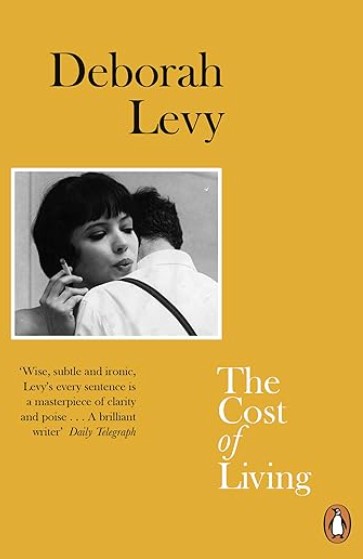
I love Levy’s autobiography so much and it is strange that it I do not take to her fictional writing at all. What makes what Levy calls her ‘Living Autobiography’ so special is that we are also inside the head of a writer and a reader and how these inform how she thinks and feels about the cost of living. In this, her second out of three, the cost is a marriage that has broken down and her mother dying.
There are so many stand out moments in what is quite a short book. When dismantling the family home at the end of her marriage, she comments:
To strip the wallpaper off the fairy tale of The Family House in which the comfort an dhappiness of men and children have been the priority is to find behind it an unthanked, unloved, neglected, exhausted woman. It takes skill, time, dedication and empathy to create a home that everyone enjoys and that functions well.
p16
As Levy settles into her existence post-marriage with her daughters she realises that she needs a room of her own to write in and is offered a shed at the bottom of Celia and Adrian Mitchell’s garden. Adrian was dead and Celia in her eighties but quite a character in her own right, with Levy referring to her as her guardian angel. Levy wrote three books in the shed, including The Cost of Living.
The appeal of writing, as I understood it, was an invitation to climb in-between the apparent reality of things, to see not only the tree but the insects that live in its infrastructure, to discover that everything is connected in the ecology of language and living.
p51
But the main reason I am drawn to Levy’s writing is that she reflects on books and their component parts. In Real Estate she pondered on the writing of real female characters and how sometimes they can be like the outline of a dead body in an old-fashioned detective story. The body is removed with the outline remaining and nothing filling in the interior. I read this straight after reading The Stone Diaries by Carol Shields and Levy’s description of writing sums up exactly what the book’s message conveys.
This time I read The Cost of Living after listening to Dream Count by Chimamanda Ngozi Adiche. In Adichee’s book we have four women who were friends but their dreams and desires were rarely fulfilled, usually because the men were never quite right. I was realy frustrated with Adiche’s first character, Chia, and her looking for love but it must be the right sort and of course no man lived up to this. And then Levy writes:
To live without love is a waste of time. I was living in the Republic of Writing and Children. I was not Simone de Beauvoir, after all. No, I had got off the train at a different stop (marriage) and stepped onto a different platform (children). She was my muse but I was certainly not hers.
All the same, we had both bought a ticket (earned with our own money) for the same train. The destination, no one knows what it looks like when we get there. It is a journey without end, but I did not know that then. I was just on my way. Where else was I to head for? I was young and lovely, I boarded that train, opened my journal and began to write in the first person and the third person.
p95
Adiche has also written about some of the characters in the book in first person and others in the third. I tend to think that those Adiche has written about in first person are reflections of herself.
One of the best reads this year.
 Trying to read all the good books
I’d love to hear what you think