
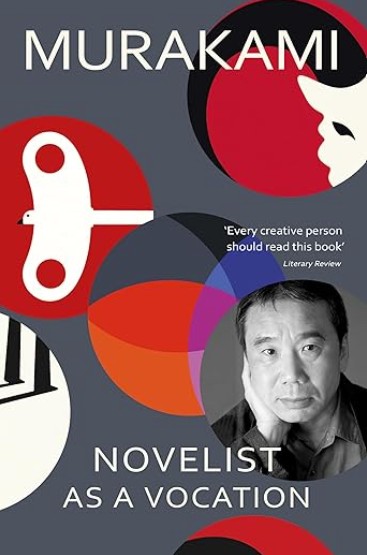
The minds of writers fascinate me because they are so different to mine. Often after reading book I will consider what a writer must have been thinking about when writing, how they seem to have brought completely separate ideas together in a story and how they decided to structure it. Novelist as a Vocation . gives us an insight into Murakami’s way of writing, a disciplined approach of 10 to 11 pages a day.
I can’t think of many other writers that found their style by writing in English and translating into Japanese but that is what Murakami did. This way of working created an ‘ unadorned ‘neutral’ style that would allow me freer movement.’ That neutral style is also used in this book and I am not an enormous fan of it.
However, there is no doubt that this is an author who has found his own way and is quite secure in it. One essay responds to the media response to his not winning a Japanese literary book prize, creating a storm over it to the degree that Murakami felt it necessary to respond with an essay. The Akutugawa literary prize is obviously big in Japan, but perhaps not so in the western world but Murakami’s opinion is that literary prizes are pointless. You write because you are an author. You play with words because you are an author. The biggest reward is readers who will pay for your books. ‘It is literary works that last, not literary prizes.’ And this is so true. I look back through some of the larger prizes and see that many of the winners have not lasted the test of time in terms of whether readers are still buying them.
Murakami is a writer who needs a particular life style to write; focused and habitual. It’s probably the same for many writers although what those habits are will vary considerably as Muarakami notes. He has written extensively about running and what that does for him, bringing the stamina to be creative for long periods of time.
And as I’ve followed this lifestyle, I get the feeling every day that my ability as a writer is gradually improving, and my creativity is becoming more secure and steady.
p118
What comes across loud and clear is that Murakami has found his way to ‘be’ as a writer, acknowledging that other writers do it differently, but he will not be deflected. It works for him, has been refined over the years and he will not be budged from it. I didn’t warm to him but I did understand him a little better which is surely what the book is about.
 Trying to read all the good books
I’d love to hear what you think