
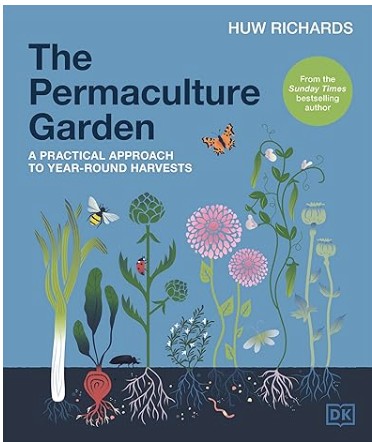
When I undertook my Permaculture design certificate, I understood that I had found my gardening home. I garden organically in a no-dig manner but neither of these provided a total solution or a way of life. Permaculture does being based on three ethics: earth care, people care and fair share, and 12+ principles as a guide for growing, and if you want to move in that direction, living.
For the certificate I wanted to read as many permaculture books as I could and although a few were written based in the UK, most were by authors in Australia or America. In fact Geoff Lawton, who led the permaculture course I attended online, lives in Australia. Whilst the climate is different, the principles stay the same but it is nice every now and then to read a book based on growing in your own country and for me, this is what The Permaculture Garden is all about. Permaculture in a temperate climate.
The book starts with a detailed exploration of the 12 principles, some of which are easier to follow than others, and here, Huw illustrates each one with examples from his gardens and growing. For instance ‘Use and value renewable resources and services’ looks at how he uses grass clippings and comfrey. ‘Produce no waste’ always focuses on humanure which is at the extreme end of the continuum of not wasting resources, but also covers composting and designing a closed loop system for the garden with no additional inputs being purchased. This principle explains why I don’t take anything from my plots to the recycling centre. There is always a way to use clippings, weeds, twigs and brambles on the plot.
The next section explores patterns and design and I have always found how to use the patterns of nature in the garden to be difficult but in fact, this section was probably the most useful for me. On the course we looked at the major patterns in nature and then how they could be used such as branching patterns, fractals, tessellations, etc but I was more interested in the patterns of climate, weeds and forests as tools to help design a vegetable plot. Who doesn’t want to maximise growing potential particularly when the allotment site is giving out half plots only to accomodate the number of people who now want a plot.
The second half of the book is a plant by plant look at the perennials you can grow in a vegetable garden, the idea being that they take less looking after but still provide a crop. I don’t think however that on a half plot they can provide enough food on their own, it is more about the balance you have between perennials and annuals linked to the amount of time you have to spend gardening. This then moves into the ideas behind growing as a polyculture.
This is an excellent book about permaculture but as every book is, this is Huw’s interpretation of it. Geoff Lawton raved about making compost in 18 days. I have tried several times and even at the height of summer, I can’t manage it. Others rave about hugelkultur beds or a spiral herb bed as if these are what make a permaculture garden. They are not. It is the principles and ethics that make a permaculture gardener and you probably wouldn’t know from my plot that I was one because I don’t have a herb spiral or a hugelkultur bed. Huw’s versions of these elements are hot beds and growing in a polyculture. All of these ways of growing fit well into the principles of permaculture but are not permaculture themselves where sometimes the outcomes of the principles mistakenly become what permaculture is. This aside, if you are interested in permaculture, the book is well-worth reading.
 Trying to read all the good books
I’d love to hear what you think