
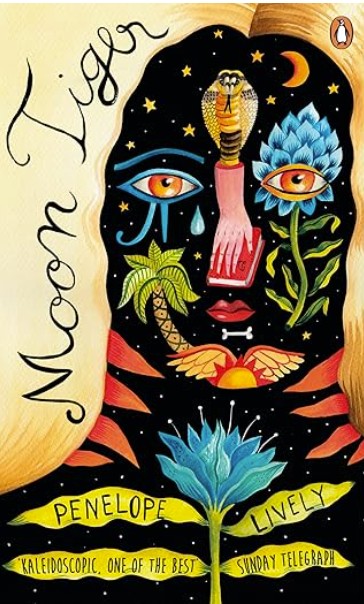
Oh, I do love this book. What I like most is the meta-ness of it. Right at the very start we read,
Chronology irritates me. There is no chronology inside my head. I am composed of a myriad Claudias who spin and mix and part like sparks of sunlight on water. The pack of cards I carry around is forever shuffled and re-shuffled; there is no sequence, everything happens at once.
p2
And so we slowly realise that as Claudia tells us about a history of the world and therefore her life, it won’t be chronologically ordered and that there may well be more than one voice. The content declares the structure, and it is so. It’s fragmented and non-linear just like memories are. We also read on p1 that this is a history of fact and fiction, myth, images and documents and understand that it’s ‘the small details that convince us history is true’.
This being a book club choice, I have questions so will start with them. This is the story of Claudia, dying and in a nursing home, looking back on her life asking us to consider what we mean by history, whose history, and to question how it is interpreted.
I can’t answer all the questions so will do just a few plus any thoughts that struck me as I read.
1. What is the significance of the title Moon Tiger and how does it illuminate the novel’s central themes?
I struggle with the title. I know from the book that the Moon Tiger is the mosquito coil that burns through the night but how that relates to the book is more of a challenge. I can see that Claudia’s life is slowly burning out or dying and there is a direct link there but as to the central themes. If we start with the central themes: love, loss, being yourself or identity and memory and something about what constitutes history. If a moon tiger burns itself out, is that what the central theme is? Nothing lasts forever; it smoulders and flares every now and then – for Claudia this would be Egypt, Gordon her brother and Tom. I will be very interested in the discussion around this point.
2. The novel frequently revisits the same events from multiple perspectives. What is the narrative effect of this technique and what does it suggest about the nature of history and truth?
As ever, the point of view or perception is one person’s and to see the whole, we need to hear other voices. It suggests that history is often a white, male version of what happened and is the truth as they wish it to be conveyed. But it is often the detail that makes history believable, more able to be understood. When my sister and I went to Glasgow we went to the museums and marvelled but what we really loved was the National Trust tenement, left in the state it had been in the 70s which was virtually untouched. We recognised items in the kitchen, in particular, that our grandparents had and were able to understand slightly more about what it was like to live there. The dates and events provided a context, but the tenement provided real life and this is why more than one voice is so necessary.
If we move this forward into the present day, whose point of view will we take and what will be recorded as history about stopping the Russia/Ukraine war? Trump’s, Putin’s or Zelensky’s or are they all valid and create a more accurate image together?
3. As Moon Tiger traces a broad arc of twentieth-century social change, how does Lively construct and navigate this historical landscape within the personal story she tells?
I think she handles this really wonderfully; lightly but just enough to anchor the story down. Without it, this narrative would be a dreams floating in the sky but the historical context, and Claudia remaining in one place in hospital, are what keep this book anchored in life. The historical context does provide a pillar to hook things to and then personal details fill the gaps between the pillars. But the two are woven together, never separate. Gordon is speaking at the start of this,
The remark attributed to Miss World 1985: “I think destiny is what you make of it.”
Does she indeed. Discuss. With special reference to a) Hernando Cortez, b) Joan of Arc, c) a resident of Budapest in 1956. Use as many sides of paper as you like.
1956; that year of Lisa’s eight birthday and of other more sonorous events. The year of The Canal; the year of Hungary.
p171
Here dates are used to provide the structure for an opinion in the form of destiny but also introduces 1956. This date then bridges the paragraph and is linked to Claudia’s daughter and Hungary which is then further developed into a personal story in the following paragraphs.
This is a way of seeing history that allows you to put yourself into world events or to see world events in the context of your life.
4. What commentary does the novel offer on the power of memory—both its reach and its limitations—in shaping our understanding of the past?
5. In what ways does the novel explore the tension between personal histories and the “official” historical record? How do two forms of history clash or converge?
I think the first quote I used suggests one of the tensions: chronology and one point of view. History is linear and factual, personal history is the opposite. It fills the gaps in ‘official’ history, it is concerned with love, complex relationships and persepctive but I don’t think the two are mutually exclusive and this is often an area that novelists will mine. There is a chapter where Claudia and her brother Gordon and his wife visit a centre which replicates Massachusetts in the 1620s. Claudia being a historian is particularly interested in the people re-enacting life or what she describes as the ‘received past’ to find the ‘wavering tenuous line’ that links the people of then to herself now. Egocentric? Yes. But the lines are there.
You affected the lives of the periwinkle and the quahaug, quiet clean-living sea creatures who found themselves turned into money, polished and drilled to become wampum, Indian hard currency in the fur trade. The price of beaver on the London market determined the value of wampum; an agreeably bizarre economic circumstance – that a hat worn under a rainy Middlesex sky should be a matter of life and death for sea-shells creeping in the shallows of Cape Cod.
p31
In some ways the factual element of the book anchors the memories which flit, and Claudia anchors the many and varied settings of the memories by being placed in one setting, that of the hospital.
So, where do these two histories converge? Perhaps in the understanding that they are both perceptions of stories that are told. Why is Claudia’s history any less accurate than the official version? It’s just that hers is a voice less often heard and is about a life. Perhaps ‘official’ history is purely a set of dates and times of events and the personal histories are what fill it out and give it meaning.
What Claudia also does in visiting this historical centre is make comments and judgements to the people about the consequences of their actions having the benefit of hindsight. When speaking to a man who wishes to farm tobacco, Claudia suggests that he doesn’t import labour so that he saves himself a whole lot of trouble later on. This judging of history by looking back at it is very relevant to us now. Can we, should we judge what happened in the past by today’s points of view? I did find this chapter quite funny although I am not sure if it was meant to be. Dark humour, perhaps, but also the past and present converging.
6. Claudia is often portrayed as both intellectually formidable and emotionally harsh. To what extent do you agree with this characterisation, and why?
7. Family relationships in the novel are marked by conflict, ambivalence, and emotional complexity. What do these dynamics reveal about the nature of family in Moon Tiger?
8. How would you characterise the relationship between Claudia and her daughter and what does it reveal about Claudia’s values or limitations? What underlying forces shape the relationship between Claudia and her brother, and how does this relationship evolve over time?
9. How do Claudia’s relationships with Jasper and Tom illuminate key aspects of her personality and worldview?
10. How do you interpret Claudia’s death? Does it read primarily as the physical end of life, or as a more existential sense of time running out?
Blimey! I had to look up the meaning of existential and in simple terms it means relating to human existence. So, is Claudia’s death a physical end of life or of time running out. The book is about more than just Claudia’s death – it’s her life and memories, not chronologically ordered but it is about time running out, the moon tiger burning down to ash and we all end up as the phrase says, ‘ashes to ashes, dust to dust’. I read this as both and end to life and a sense of human time running out. Memories are only available if the people who were involved are around, not dead, or they have been recorded in some way. So, they are ephemeral but also can have an end with the physical. I shall be really interested to see what others say about this question!
Other elements
Things that I noticed but are not part of the questions:
- feminism
- the role of incest in the novel
- how well she describes Egypt during WW11 and its centrality to the novel
- WW11 stretching back to WW1 and forwards to being sent Tom’s diary
 Trying to read all the good books
I’d love to hear what you think