
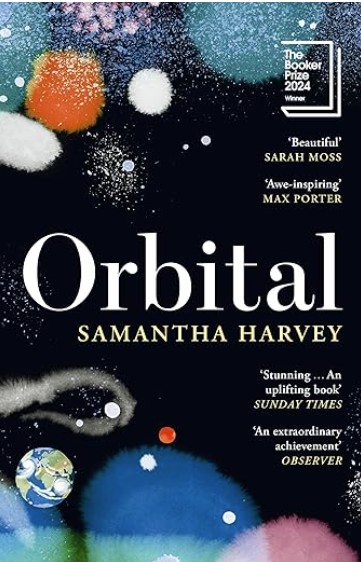
I don’t know if you remember those coffee table books consisting of satellite images of earth? Well, this is a book that takes the awe and wonder of those pictures and turns them into words.
Orbiting 250 miles high in space six astronauts, four American and two Russian, go about their daily business in space witnessing across a day sixteen sunrises and sunsets, capturing many images on camera. The views are stunning and the astronauts are often pulled towards the windows to observe ‘Cuba pink with the morning’, Africa ‘the paint-splattered, ink-leached, crumpled-satin, crumbled-pastel overflowing-fruit-bowl continent of chaotic perfection’, and the ‘Tunisian salt flats in cloisonne pink’.
These views then provide Harvey with the opportunity to reflect on the earth and what we are doing to it. She covers it all from the fact that less light is reaching space because it is being absorbed by the earth making it hotter to the fact that boundaries are not visible from on high. This is contrasted with rules on the space station
You will now have to pay to use our toilet facilities, the Russian Space Agency has said to those of America, Europe and Japan, and so those agencies have reponded in kind: go right ahead, our toilet is better than yours. And neither can you use our exercise bike. Well you can’t access our food stores then.
p63
Space is a wealthy nation playground! This separation and then coming together to marvel at the beauty of the planet is something that provides a pulse throughout the book.
There are reflections on how the universe was created. One of the astronauts is a creationist so the question is God or the Big Bang?
Is Shaun’s universe just the same as hers but made with care, to a design? Hers an occurrence of nature and his an artwork? The difference seems both trivial and insurmountable.
p45
There’s politics shaping the earth, just as gravity does and there is the question of the purpose of humans: to search for life out there? And out of the blue, briefly, Harvey wonders how the moon feels.
Over fifty years without a human foot on its back, our moon, and does it turn its bright side in longing to the earth in the hope of the humans’ return? Does it, and all of the other moons and planets and solar systems and galaxies, yearn to be known?
p31
Who knows?
The writing is dense. It is not a novella that you can whip through in an hour. It is almost as if we are in the space ship with the astronauts going round and round and round. The research must have been tremendous and is used to good effect. There are many snippets of text that are wise, thoughtful and attempt to answser some of the BIG questions.
The planet is shaped by the sheer amazing force of human want, which has changed everything, the forests, the poles, the reservoirs, the glaciers, the rivers, the seas, the mountains, the coastlines, the skies, a planet contoured and landscaped by want.
p75
I marvelled at the quality of the writing and the depth of thinking. I haven’t read much else like it, but . . . I didn’t warm to the book, the astronauts as characters or the magnificence of what we have achieved. Without a strong story arc the writing becomes repetitive with only the tracking of the typhoon to add a destructive and moving thread throughout the cycles of orbit. It is fiction that is so very near to being non-fiction.
Planet earth is the centre of this book’s universe. It is the ‘ever-electric blue pull’ of us all.


I’d love to hear what you think